 One of the world's oldest civilizations, China boasts a chronicled history of more than 5,000 years. One of the world's oldest civilizations, China boasts a chronicled history of more than 5,000 years.
In the 21st century BC China saw the end of long years of primitive society and the beginning of the slave society with the founding of the Xia Dynasty. The Xia was followed by the Shang and Western Zhou dynasties. Then came the Eastern Zhou, which encompassed the Spring and Autumn and Warring States periods.
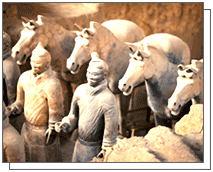
In 221 BC, Qinshihuang founded the Qin Dynasty, the first feudal autocracy in Chinese history that unveiled more than 2,000 years of feudalism which, until its demise in the Opium War of 1840, saw the rise and fall of a succession of dynasties like the Han, Tang, Song, Yuan, Ming and Qing.
The Chinese civilization reached an apex early in ancient times. As early as the Shang 3,000 years ago, the Chinese had invented the art of bronze metallurgy and iron tools. A galaxy of distinguished thinkers, scientists, artists and writers emerged in the intervening years. The Chinese of ancient times were known for their brilliant achievements in mathematics, medical science, astronomy, agriculture, architecture, and many other fields. The world never looked the same after the Chinese came up with the four major inventions: papermaking, mobile block printing, powder and the compass.
The bourgeois democratic revolution of 1911 led by Dr Sun Yat-sen toppled the rule of the Qing Dynasty, terminating more than two millennia's feudal monarchy, and culminating in the establishment of the provisional government of the Republic of China.
October 1, 1949 saw the founding of the People's republic of China. Today, in transition to a socialist market economic system under the policy of reform and opening up to the rest of the world, China is blazing a new trail in building socialism the Chinese way.
|