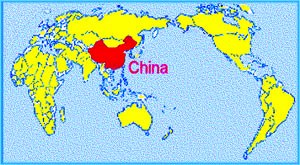
 The vast territory of China stretches north and south for approximately 5,500km (about 50 latitudinal degrees) from the central line (53°31'N) of the Heilongjiang River at Mohe Town in Heilongjiang Province to the Tsengmu Reef (4°15'N) in the southernmost part of the South China Sea Islands; and east and west for 5,000 km (about 62 longitudinal degrees) from the confluence of the Heilongjuang and Wusulijiang rivers (135°5'E) to the Pamirs(73°40'E) in Xinjiang. China's geographical position in esastern Asia and on the western shore of the Pacific enables it to maintain close ties with landlocked neighbours in the we The vast territory of China stretches north and south for approximately 5,500km (about 50 latitudinal degrees) from the central line (53°31'N) of the Heilongjiang River at Mohe Town in Heilongjiang Province to the Tsengmu Reef (4°15'N) in the southernmost part of the South China Sea Islands; and east and west for 5,000 km (about 62 longitudinal degrees) from the confluence of the Heilongjuang and Wusulijiang rivers (135°5'E) to the Pamirs(73°40'E) in Xinjiang. China's geographical position in esastern Asia and on the western shore of the Pacific enables it to maintain close ties with landlocked neighbours in the we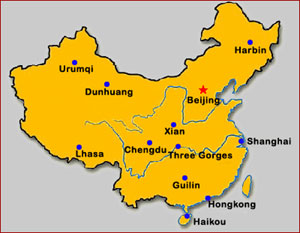 st and reach out to countries across the sea. The abundance of rainfalls precipitated by moist air currents from the sea is a major source of freshwater essential to agricultural development in this country. The coastal regions provide ample space for maritime undertakings. st and reach out to countries across the sea. The abundance of rainfalls precipitated by moist air currents from the sea is a major source of freshwater essential to agricultural development in this country. The coastal regions provide ample space for maritime undertakings.
As the Tropic of Cancer runs across the southern part of China, which belongs to the Northern Hemisphere, the lion's share of the Chinese territory finds itself in the northern temperate zone, and a small part of it is in the tropical zone. A wide latitudinal span has endowed China with oenty of sunshine and solar energy, and this is conducive to the growth of a good variety of animals and plants.
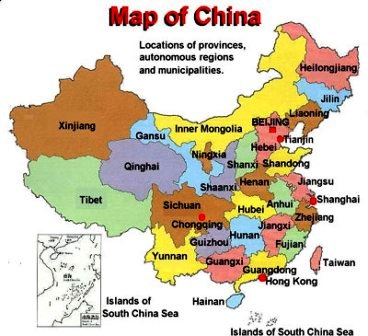
Covering an area of 9.6 million square km, which is approximately one-fifteenth of the earth's land area or about the same size as Europe, China s the world's third largest country behind Russia and Canada.
|